Don't Just Sit There!
How bathroom posture affects your health.
By Daniel Lametti
Posted Thursday, Aug. 26, 2010, at 10:17 AM ET

Shortly before Christmas in 1978, the leader of the free world came down with a severe case of hemor! rhoids. The pain was so bad that President Carter had to take a day of f from work. A few weeks later,
Time Magazine asked a proctologist named Michael Freilich to explain the president's
ailment.
"
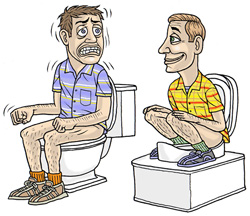
We were not meant to sit on toilets," he said, "we were meant to squat in the field." He's probably right.
Michael Freilich isn't the first doctor to suggest that sitting on toilets—a recent phenomenon, stemming from
the invention of the flush toilet in 1591—might be unhealthy. By the 1960s and '70s, the idea was relatively commonplace. Architect Alexander Kira argued in his 1966 book
The Bathroom that human physiology is
better suited to the squat. According to Bockus's
Gastroenterology, a standard medical text
from 1964
, "
the ideal posture for defecation is the squatting position, with the thighs fixed upon the abdomen."
Modern-day squat evangelists make money off the claim that a "more natural" posture wards off all sorts of health problems, from Crohn's disease to colon cancer.
Inventor
Jonathan Isbit runs a modest online business selling Nature's Platform—a homemade, $150 device that fits over toilets to make them more lik! e holes in the ground.
* (He also
posted the Bockus quote above to the Wikipedia entry on
defecation.) Other entrepreneurs peddle similar products, like the
In-Lieu, the
Lillipad, the
Evaco toilet converter, and, for those who don't like explaining their squat platform to house guests,
a $688 Singaporean toilet that lets users switch among different squatting and sitting postures, from the "East Asian squat" to the "aft sit."
* (Confused? Watch the
video.)
That may sound like a bunch of Internet quackery, but there's now some e! mpirical evidence for the claim that defecation posture affects your body. The more extreme assertions about squatting—that it prevents cancer, for example—remain untested. But when it comes to hemorrhoids—a painful swelling of the veins in the anal canal that affects
half of all Americans—new research suggests that you may want to get your butt off the toilet.
Before we dive into the data, let's review the mechanics of going to the bathroom. People can control their defecation, to some extent, by contracting or releasing the anal sphincter. But that muscle can't maintain continence on its own. The body also relies on a bend between the rectum—where feces builds up—and the anus—where feces comes out. When we're standing up, the extent of this bend, called the anorectal angle, is about 90 degrees, which puts upward pressure on the rectum and keeps feces inside. In a squatti! ng posture, the bend straightens out, like a kink ringed out of a gard en hose, and defecation becomes easier.
Proponents of squatting argue that conventional toilets produce an anorectal angle that's ill-suited for defecation. By squatting, they say, we can achieve "complete evacuation" of the colon, ridding our bowels of
disease-causing toxins. But there's no reason to think that getting into a squat will make defecation more complete, nor that most people are sickened by their colons. If squatting does provide a health benefit, just as Michael Freilich stated in
Time, it comes in the form of hemorrhoid prevention.
Hemorrhoids may be brought on by pregnancy, obesity, and receiving anal sex. But the main cause is straining during bowel movement.
Straining increases the pressure in your abdomen, causing the veins that line your anus to swell. In hemorrhoi! d patients, those veins stay swollen and sometimes bleed. In theory, squatting might stave off hemorrhoids by making defecation easier, reducing the need to strain and decreasing abdominal pressure.
An Israeli doctor named Dov Sikirov tested this idea for a
2003 study published in
Digestive Diseases and Sciences. He had several dozen patients defecate in each of three positions: sitting on a 16-inch-high toilet, sitting on a 12-inch-high toilet, and squatting over a plastic container. He asked his subjects to record how long each bowel movement took and rate the effort required on a four-point scale ranging from effortless to difficult. Sikirov found that, when squatting, subjects averaged a mere 51 seconds to move their bowels, versus 130 seconds when sitting on a high toilet. And as they moved from a sit to a squat, subjects were more likely to rate the experience as easier! .
Then last year, a group of Japanese doctors extended Sikirov' s findings by looking at what happens inside the body while people squat and sit. For a
study published in the medical journal
Lower Urinary Tract Symptoms, six subjects had their rectums filled with a contrast solution and then released the fluid from a squatting or a sitting position while being filmed with X-ray video. Image analysis showed that the anorectal angle increased from 100 degrees to 126 degrees as the subjects moved from a sit to a squat. The researchers also recorded abdominal pressure, and found that the subjects were straining less when they squatted.
Of course, it's one thing to show that squatting streamlines defecation and reduces hemorrhoid risk. It's another to actually move your bowels while you squat. But how hard could it be? For most of human history—several hundred thousand years—we've squatted. Today, 1.2 billion people s! quat because they simply
don't have a toilet, while many, many more in Asia, the Middle East, and parts of Europe use toilets designed specifically for squatting. And for 28 years—from his junior year at Yale in 1970 to the moment when he completed the first Nature's Platform prototype in 1998—Jonathan Isbit "perched," as he put it, squatting on the rim of toilet seats. So I decided to try it—each morning for a week, following a bowl of corn flakes and a cup of coffee.
Besides tipping over, there's little danger in squatting over a modern sit toilet. Both American Standard and Kohler say that floor-mounted toilets are designed to hold at least 1,000 pounds. (Still, neither company recommends perching.) The American Society for Engineers requires that wall-mounted toilets
hold 500 pounds. But squatting on your toile t seat is not for everybody. Even when I was holding onto a towel rack, the situation felt precarious. A bedpan or a plastic container would have been easier, but I didn't have the former and the latter seemed gross. So I forged ahead, pushing through the week—or, as it turned out, not pushing: Bowel movements just seem to happen in a squat. My 10-minute routine dropped to a minute, two at the most, and within a few days my knees stopped complaining.
Although the week is now over, I'll probably squat again. At the very least, I gained an hour over seven days. It seems doubtful, though, that squatting, even if it helps hemorrhoids, will become the next back-to-nature craze—the new
barefoot running shoe or
caveman diet. Sit toilets, in the short term at lea! st, are more comfortable than the squat toilets you might find in Europe. In fact, since Jimmy Carter's bout of hemorrhoids sit toilets have actually grown in height, pushing the anorectal angle in the wrong direction. Standard models, 14 inches from floor to rim, now compete with "
comfort height" toilets that tower more than 17 inches of the floor. Americans, now fatter than ever, are having trouble standing up from a sit, never mind a squat.
Like Slate on Facebook. Follow us on Twitter.
Correction, Aug. 27, 2010: This article originally misspelled the first name of Jonathan Isbit. (Return to the corrected senten! ce.)
Correction, Sept . 13, 2010: The original sentence described the $688 toilet as being Japanese. (Return to the corrected sentence.)
Daniel Lametti is a scientist and writer who lives in Brooklyn.
Article URL: http://www.slate.com/id/2264657/
© 2010 Washingtonpost.Newsweek Interactive Co. LLC


 (HarperCollins) with exercise performance physician Max Testa, M.D., and DeAnne Musolf. www.heidenothopaedics.com)
